Explained: What Pakistan’s New IBCC E-Marking System Means for Students in 2026
Pakistan has officially moved one step closer to digital exam checking. In February 2026, the Inter Boards Coordination Commission (IBCC) confirmed it has finalized specialized software for nationwide E-marking across all educational boards. This change affects matric and intermediate students in every province. Exam papers will now be scanned and checked on computers. This is more than a tech upgrade. It is a real structural reform.
📋 Table of Contents
- What Is IBCC and Why This Reform Matters
- Why Pakistan Needed E-Marking
- How the E-Marking System Works Step by Step
- Which Boards Have Implemented It
- What Changed Compared to Previous Years
- Real Benefits for Students and Boards
- Practical Challenges and Concerns
- E-Marking vs Manual Marking
- Will Results Be Faster in 2026?
- What Students Should Do Now
- Frequently Asked Questions
1. What Is IBCC and Why This Reform Matters
The Inter Boards Coordination Commission is the national body that coordinates policies among Pakistan’s educational boards. It works with the Federal Board of Intermediate and Secondary Education and all provincial BISE boards in Punjab, Sindh, KP, and Balochistan. You can verify official announcements on the IBCC website.
The commission ensures uniform standards in exams and certifications. Now, with the introduction of centralized E-marking software, IBCC aims to bring transparency and consistency across all boards.
This matters because over 2 million students appear in matric and intermediate exams every year across Pakistan. When a system affects millions, even small improvements can make a big difference.
Pakistan’s exam system oversees millions of students annually. Photo: Pexels
For reference, provincial education statistics are published on official government portals such as punjab.gov.pk and education.sindh.gov.pk.
2. Why Pakistan Needed E-Marking
For years, Pakistan’s manual marking system faced serious criticism. Students regularly complained about totalling mistakes, delayed results, inconsistent marking, and lengthy rechecking processes.
⚠️ Problems with the Old System
- Totalling errors by hand
- Result delays affecting university admissions
- Inconsistent marking standards across boards
- Slow rechecking with limited transparency
Manual systems depend heavily on human calculation. Even experienced examiners can make addition errors when checking thousands of scripts. Result delays often affect university admissions. Students applying to public universities must submit results on time. Delays create real stress.
The Ministry of Federal Education and Professional Training has emphasized digital reforms in public education. Official updates can be found at moent.gov.pk. IBCC’s move toward E-marking aligns with broader government digitization goals. In short, the reform aims to restore public trust in the exam system.
You may also find these related guides useful: Intermediate Board Exam Dates in Punjab and Punjab Board’s Exam Security CCTV Updates.
3. How the E-Marking System Works Step by Step
The system follows a clear and structured process.
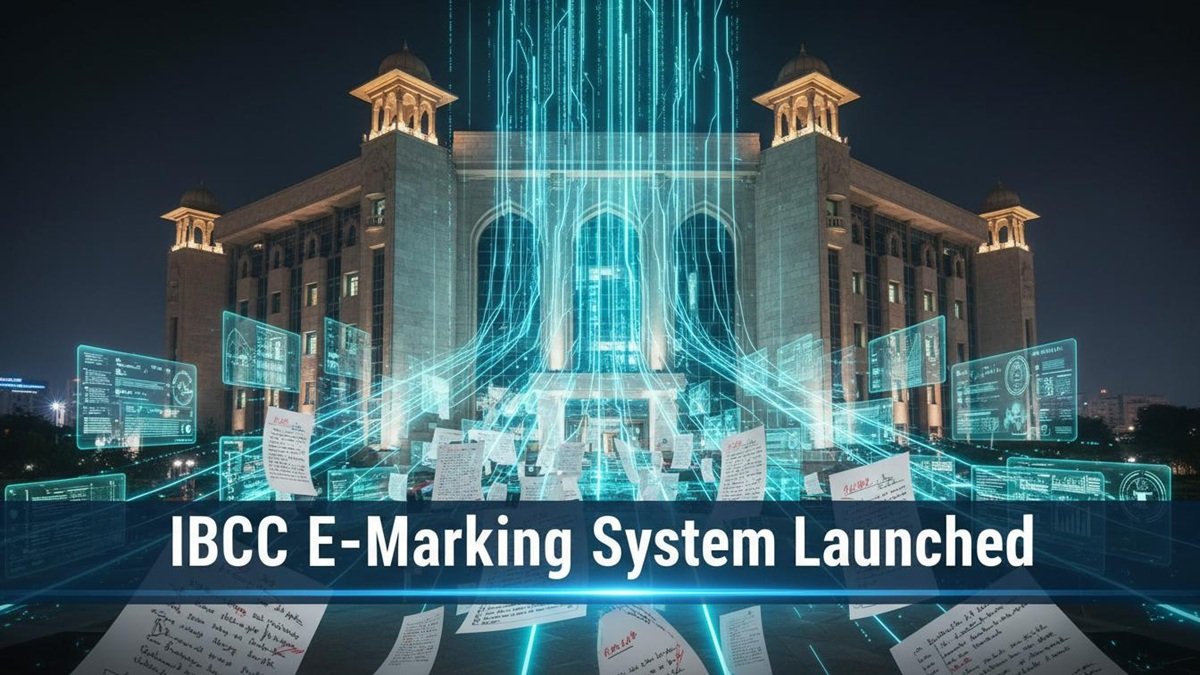
Answer sheets are scanned and distributed digitally to examiners.
Step 1: Secure Scanning
After exams, answer sheets are scanned at designated centers. Each paper receives a QR code or barcode. This ensures secure identification of every script.
Step 2: Creation of Digital E-Sheets
The scanned scripts become digital E-marking sheets. Student names remain hidden to prevent bias.
Step 3: Question-Wise Distribution
Instead of giving one full paper to one teacher, the software divides scripts by questions.
- Examiner A checks Question 1 for 500 students
- Examiner B checks Question 2
- Examiner C checks Question 3
This reduces the chance of personal bias significantly.
Step 4: Online Evaluation
Teachers log into a secure portal using assigned credentials. Monitoring tools maintain accountability throughout the process.
Step 5: Automatic Totalling
Once all questions are marked, the system automatically calculates totals. That removes arithmetic mistakes entirely.
This model has already been tested by boards such as the Board of Intermediate and Secondary Education Lahore. Official updates are available at biselahore.com.
4. Which Boards Have Implemented It
✅ Punjab
Punjab took early steps toward digitization. Along with E-marking, CCTV monitoring of practical exams and biometric verification were introduced. Updates can be tracked at punjab.gov.pk.
✅ Sindh
Sindh boards prepared scanning centers and QR tracking for 2026 exams. Training sessions were conducted with IBCC coordination. Official portal: education.sindh.gov.pk.
✅ Federal Board (FBISE)
The Federal Board of Intermediate and Secondary Education aligned with IBCC’s finalized software for phased adoption. Official website: fbise.edu.pk.
As of February 2026, IBCC confirmed readiness for a nationwide rollout in upcoming annual exams.
5. What Changed Compared to Previous Years
In 2025, digital marking was limited to pilot projects. Some pilots faced technical adjustments, server slowdowns, and examiner training gaps. But 2026 marks the first coordinated national deployment.
Now there is centralized finalized software, standardized training across all boards, QR tracking for every script, and digital audit logs for full accountability. This shift from pilot to national rollout is the biggest change in Pakistan’s exam history.
6. Real Benefits for Students and Boards
📊 Key Improvements Expected
- Fewer Totalling Errors — Automatic calculation removes arithmetic mistakes
- Greater Transparency — Multiple examiners check different sections, reducing bias
- Digital Audit Trail — Every marking action is logged for dispute resolution
- Faster Compilation — Digital aggregation saves weeks of manual counting
Education analysts argue that technology alone does not guarantee fairness. However, when implemented carefully, it improves accountability across the board.
Also read: Punjab’s IT Certification Program — A Complete Guide for more on Pakistan’s digital education push.
7. Practical Challenges and Concerns
Reforms always bring challenges. This one is no different.
⚠️ Areas That Need Attention
- Teacher Adaptation — Some examiners prefer manual checking. Screen-based marking requires adjustment and training.
- Infrastructure Needs — Stable servers and reliable internet are essential. Rural regions may need upgrades.
- Cybersecurity — Exam data must remain protected. Boards must invest seriously in data security.
IBCC officials have indicated that phased monitoring will continue through 2026 to address issues early. According to the British Council Pakistan, digital assessment reforms succeed when examiner training is thorough and ongoing.
8. E-Marking vs Manual Marking
| Feature | E-Marking | Manual Marking |
|---|---|---|
| Paper Handling | Scanned digitally | Physical bundles |
| Mark Distribution | Software based | Manual assignment |
| Totalling | Automatic | Hand calculated |
| Transparency | Logged digitally | Limited trace |
| Error Risk | Lower clerical risk | Higher addition risk |
Manual marking is familiar and trusted. However, it carries higher arithmetic risk. Digital systems reduce addition errors but require technical stability to work well.
9. Will Results Be Faster in 2026?
If the system runs smoothly, results could be compiled faster. Automatic totalling removes weeks of manual addition work. However, first-phase adjustments may cause minor learning delays for examiners. Always rely on official sources. Do not trust social media rumors.
Students should check results directly from:
- IBCC: ibcc.edu.pk
- FBISE: fbise.edu.pk
- Provincial board portals
10. What Students Should Do Now
Students do not need to change how they study. Focus on clear handwriting and official channels.
Students do not need to change how they prepare. The paper pattern remains the same. However, they should keep these points in mind:
- Focus on clear handwriting for scanning quality
- Fill roll numbers correctly and completely
- Keep track of official board announcements only
- Avoid unofficial groups and social media rumours
Related reading: Certificate Attestation Guide for Pakistan — useful for students heading to universities abroad.
Frequently Asked Questions