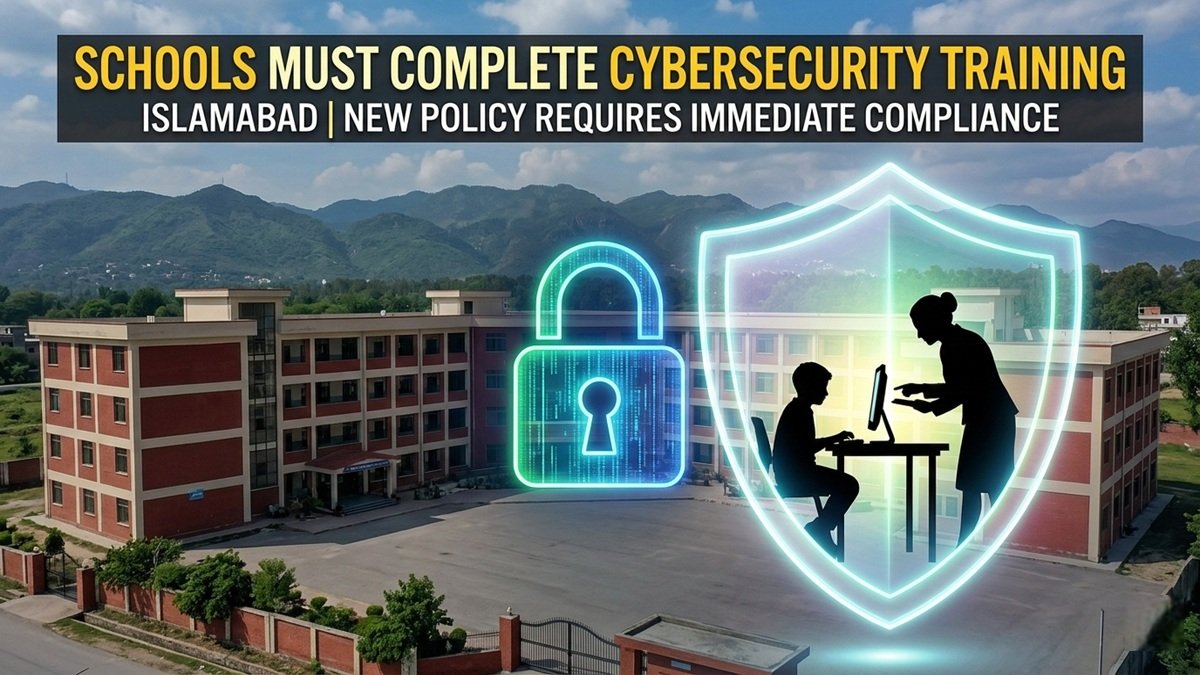
Pakistan Orders Mandatory Digital Safety & Cybersecurity Training in Private Schools
What Islamabad’s New Policy Means for Teachers, Students, and Parents
Pakistan has made a major shift in school policy. The federal government has now made cybersecurity training for teachers and digital safety training mandatory in private schools and colleges in Islamabad. This is not just another advisory. It is a compulsory requirement with fixed deadlines. Private institutions regulated by the Pakistan Education Regulatory Authority must ensure staff and students complete approved courses before March 2026.
📋 Table of Contents
- What the New Policy Says
- Official Deadlines at a Glance
- Why the Government Took This Step
- What Students and Teachers Will Learn
- How to Register Step by Step
- Compliance Rules and Possible Consequences
- How Public Schools Are Responding
- Punjab’s Earlier Digital Safety Model
- What Changed Compared to Last Year
- Why This Matters for Families
- What Happens Next
- Frequently Asked Questions
What the New Policy Says
According to official information available on the Ministry of Federal Education and Professional Training website, all teachers and non-teaching staff who use digital devices must complete an online cybersecurity training program.
Students from Grade 9 onward must register for a digital safety course. The training will be delivered in partnership with Cisco through its Networking Academy platform. Course details are publicly available at netacad.com.
Institutions must:
- Ensure 100 percent registration of eligible staff
- Register Grade 9 and above students
- Conduct Continuing Professional Development sessions in early March
- Submit compliance reports by March 9
This applies immediately to private schools and colleges in Islamabad under PEIRA regulation. In simple words — this is mandatory, not optional.
Official Deadlines at a Glance
Here is a simplified summary for quick reference. Because the deadlines are tight, schools are advised to begin registrations immediately.
| Category | Requirement | Deadline |
|---|---|---|
| Teachers and Staff | Complete cybersecurity training | March 8, 2026 |
| Students Grade 9+ | Register for digital safety training | Before March 8, 2026 |
| Institutions | Submit compliance report | March 9, 2026 |
| CPD Sessions | Conduct awareness sessions | First week of March |
⚠️ Urgent Notice: All deadlines fall within the first week of March 2026. Schools that have not started registration must act immediately. Delay could trigger regulatory consequences under PEIRA rules.
Why the Government Took This Step

Cyber risks targeting young people and educational institutions are growing rapidly — Photo: Pexels
Cyber risks in Pakistan are rising. The National Response Centre for Cyber Crime (NR3C), operating under the Federal Investigation Agency, regularly reports online fraud, phishing scams, and identity theft cases.
At the same time, the Pakistan Telecommunication Authority reports that internet usage continues to expand across the country. Young people form a large part of these users.
🔴 The Real Threat: Schools have become soft targets for phishing emails, fake scholarship links, ransomware attempts, and data leaks. An Islamabad-based cybersecurity consultant explained that most school data breaches happen due to simple human mistakes. Weak passwords, unknown attachments, and shared login credentials often create openings for attackers.
So instead of reacting after damage, the government has chosen prevention. This is a smart move. It shifts responsibility from response to readiness.
What Students and Teachers Will Learn
The cybersecurity training program focuses on practical and real-world threats. Courses offered through Cisco Networking Academy include Introduction to Cybersecurity and Digital Safety fundamentals.
🛡️ Core Topics Covered
- How phishing emails work
- How ransomware spreads
- How to create strong passwords
- Why two-factor authentication matters
- Safe social media privacy settings
- How to identify fake news and deepfakes
- Secure WiFi practices
- Safe device updates
Good News for Students: These are beginner-friendly modules. Students can complete the digital safety course during summer vacations so exams are not affected. Certificates are issued after successful completion. This can also help students interested in IT careers.
Want to know more about digital skills programs in Pakistan? Read our coverage on the Global IT Certification Program by Punjab PITB.
How to Register Step by Step

Registration is online and free through the Cisco NetAcad platform
Parents and school administrators should follow these steps carefully.
- Visit the Ministry’s official portal at mofept.gov.pk
- Access the skills or training section
- Use the official link provided by school administration
- Create a new Cisco NetAcad account with a fresh email
- Verify the email address
- Select Introduction to Cybersecurity or Digital Safety
- Complete all modules and quizzes
- Download the completion certificate
If technical help is needed, Cisco support resources are available at netacad.com/support. Schools must maintain completion records for reporting.
💡 Tip for School Heads: Do not wait until the last day. Assign a dedicated coordinator who tracks registration progress daily. A shared Google Sheet or school management portal can help monitor completion rates in real time.
Compliance Rules and Possible Consequences
Authorities have clearly stated that non-compliance will not be tolerated. While specific fines are not publicly detailed, PEIRA regulations allow disciplinary measures under school registration rules.
⚠️ Possible Consequences for Non-Compliance
- Written warnings issued to school management
- Financial penalties under regulatory rules
- Suspension notices for repeated violations
- License review in serious cases
School heads are personally responsible for ensuring full completion and timely submission of compliance reports.
How Public Schools Are Responding
Public institutions under the Federal Directorate of Education are also following similar guidelines. Islamabad Model Schools are organizing lab-based group registrations, CPD awareness sessions, and centralized tracking of course completion.
However, public schools often face limited device availability. Therefore, they are arranging shared access during non-class hours. This shows that digital safety training is being treated as a system-wide reform — not just a private sector measure.
Punjab’s Earlier Digital Safety Model
Before Islamabad’s mandate, Punjab introduced a pilot program called Digital Safer Future. The initiative was led by the Punjab Information Technology Board in collaboration with the School Education Department. Thousands of teachers in selected districts received training on phishing prevention and safe online practices.
However, that program remained limited in scope. The new Islamabad mandate is different because it introduces compulsory registration and compliance reporting. This signals a move from pilot awareness to enforceable policy.
For related education policy news, see: IBCC E-Marking Pakistan Board Exams and FBISE 2026 Exams Date Sheet Class 9-10.
What Changed Compared to Last Year
| Aspect | Last Year (2025) | Now (2026) |
|---|---|---|
| Training Requirement | Optional workshops in many schools | Mandatory for all eligible staff and students |
| Deadlines | No fixed deadlines | Hard deadline: March 8–9, 2026 |
| Reporting | No mandatory reporting system | Compliance reports due March 9 |
| Consequences | No regulatory consequences | PEIRA action for non-compliance |
Why This Matters for Families
Pakistan mandates cybersecurity training across private schools and colleges — Photo: Pexels
Parents should understand the benefits clearly. This policy improves student privacy protection, safe online classroom practices, awareness of cyberbullying, responsible social media use, and early career readiness in technology.
The Long-Term Value: Digital literacy is part of modern life. If students learn safe habits early, they carry those habits into universities and workplaces. This training is not just about school safety. It is an investment in Pakistan’s digital future.
Why This Is Bigger Than Just One Course
This policy aligns with Pakistan’s broader Digital Pakistan vision. Schools are becoming digitally connected. Attendance, exams, communication, and payments increasingly use online systems. Without proper cybersecurity training, these systems remain vulnerable.
🔑 Key Insight: By making cybersecurity training for teachers mandatory, the government is closing a weak link. In many cyber incidents worldwide, human error is the main cause. Training reduces that risk. This reform focuses on behavior change, not just technology. That is the difference between a policy that looks good and one that actually works.
For more on global cybersecurity education trends, see the ITU Cybersecurity Resource Guide and Cisco’s research on cybersecurity workforce development.
What Happens Next
If Islamabad’s rollout succeeds, expansion to other provinces is likely. Future updates may include advanced cybersecurity training courses for higher grades, annual refresher training for staff, and integration into national curriculum standards.
📌 Stay Updated: Parents should watch official announcements on mofept.gov.pk for the latest updates on this mandate and any nationwide expansion.
Frequently Asked Questions
Q: Who must complete the cybersecurity training?
All teachers and non-teaching staff using digital devices in PEIRA-regulated private institutions must complete it by March 8, 2026.
Q: Are students required to participate?
Yes. Students from Grade 9 onward must register for the digital safety course before March 8, 2026.
Q: Is there a fee for the training?
No. Courses provided under the Cisco Networking Academy partnership are completely free for all eligible participants.
Q: What if a school does not comply?
Regulatory action may be taken under PEIRA rules, which can include written warnings, financial penalties, suspension notices, or license review in repeated cases.
Q: Which platform is used for the training?
Training is delivered through the Cisco Networking Academy platform at netacad.com, covering Introduction to Cybersecurity and Digital Safety modules.
Q: Will this mandate expand to other provinces?
There is no official nationwide date yet. However, based on the current policy direction, expansion to other provinces remains possible.
Q: Can students complete training during school holidays?
Yes. Students can complete the digital safety course during summer vacations so regular exams and classes are not affected.
Q: Will students receive a certificate?
Yes. Certificates are issued upon successful course completion through Cisco Networking Academy. These certificates can also benefit students pursuing IT careers.