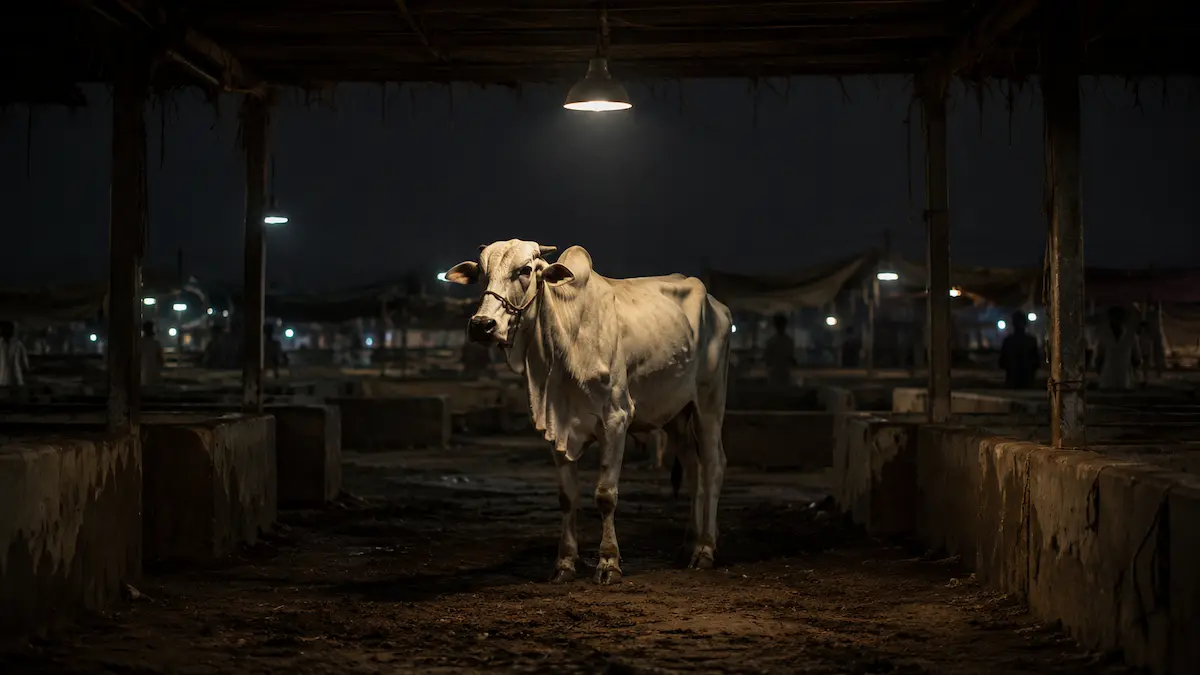
Pakistan’s Qurbani Market Slowdown — What Really Happened
Cattle markets in Rawalpindi, Lahore, and Karachi all reported weaker-than-usual activity this Eid. Buyers delayed purchases until the final days before Eid, forcing traders to cut prices repeatedly just to move animals.
According to the Pakistan Economic Survey, livestock is the country’s largest agricultural sub-sector and supports millions of rural households directly. A weak Qurbani season therefore ripples far beyond the cattle market.
Why Families Cut Back On Qurbani Spending This Year
Several financial pressures hit households at the same time. High electricity bills, rising food costs, school fee pressure, and slower salary growth left many families with less money than in previous years.
As a result, buyers increasingly moved toward shared Qurbani groups, smaller animals, last-minute discounted purchases, and charity-based sacrifice programs. This shift was visible across every major cattle market in Pakistan.
This connects directly to what analysts have flagged in the Budget 2026 income tax and pension discussions — household purchasing power remains under serious strain.
How 2026 Differed From Earlier Eid Seasons
In earlier years, premium cows and large breeds sold quickly weeks before Eid. Urban buyers would book animals early and traders would enter the season with confidence.
This year that pattern broke down completely.
| Market Trend | Earlier Years | 2026 Situation |
|---|---|---|
| Buyer activity | Strong before Eid | Slow until final days |
| Large animal demand | High | Weak in many cities |
| Shared Qurbani | Limited | Much more common |
| Trader confidence | Stable | Under pressure |
| Unsold animals | Lower | Reported across markets |
Why Goat Prices Stayed High While Cow Prices Fell
One unusual pattern this Eid was the gap between goat and cow prices. Large animals saw sharp discounts near Eid in several markets. Goats and sheep, however, stayed expensive throughout the season.
When many middle-class families could no longer afford large cows, demand shifted toward smaller animals. That shift kept goat prices firm even as cow prices dropped due to oversupply.
Farmers also reported higher costs for animal feed, transportation, fuel, and market fees — all of which squeezed profit margins further.
The Hidden Crisis Most People Are Missing
Weak sales this year are only part of the problem. The bigger concern is what happens to livestock farming over the next few years.
Many farmers raise animals for months before Eid, hoping to recover costs through seasonal sales. If profits disappear repeatedly, fewer farmers will invest in breeding. That means future supply may fall — and meat and dairy prices could rise sharply later.
This situation also puts pressure on rural employment. For many villages, Eid ul Adha is a major income season. Livestock earnings help families pay for school expenses, medical bills, farming supplies, and loan repayments.
Why Rural Pakistan Faces The Biggest Risk
Smaller farmers operate with limited savings and narrow profit margins. They cannot absorb repeated seasonal losses the way large commercial operations can.
Continued weakness in Qurbani markets could push many small-scale farmers out of the business entirely. That would reduce competition, tighten supply, and eventually drive prices up for consumers.
Salary and income pressures remain a key factor. The government’s salary increase announcements for government employees in Budget 2026 may offer some relief, but private sector workers and rural households still face significant financial stress.
A Permanent Shift In How Pakistanis Perform Qurbani
The move toward shared and collective Qurbani is not just a one-year response to tight budgets. Consumer habits often change permanently during financial stress.
Many families who switched to shared sacrifice arrangements this year may continue that approach even if conditions improve. That makes this shift different from a normal seasonal market slowdown.
What Happens Next For Pakistan’s Livestock Industry
Traders and industry groups believe the next two to three years will be critical. If weak demand continues, the consequences could be serious.
| Possible Future Trend | Likely Impact |
|---|---|
| Farmers reduce breeding stock | Future animal shortages |
| Small traders exit markets | Lower competition |
| Supply declines later | Prices may rise sharply |
| Shared Qurbani grows | Permanent market shift |
| Rural earnings weaken | More financial pressure |
Ironically, today’s weak demand could create much higher livestock prices in the future if production falls over time. This pattern has played out before in smaller agricultural cycles across Pakistan.
Government Response And Policy Gaps
So far, there has been limited direct relief specifically targeted at livestock traders and feedlot farmers. Industry groups have suggested easier agricultural financing, livestock insurance systems, fodder support, and meat export promotion as possible measures.
The Ministry of National Food Security and Research regularly publishes agriculture policy updates. However, many traders believe much stronger support will be needed if losses continue across multiple Eid seasons.
Frequently Asked Questions
Why did Pakistan’s Qurbani market weaken this year?
The main reasons include inflation, weaker purchasing power, and rising livestock farming costs. Many families reduced Eid spending or switched to shared Qurbani arrangements.
Why were goat prices expensive despite weak overall markets?
Demand shifted toward smaller animals because many families could not afford large cows. This kept goat and sheep prices elevated even as large animal prices fell due to oversupply.
Could livestock prices rise again in the future?
Yes. If farmers reduce breeding stock due to continued losses, future supply shortages may push prices significantly higher over the next few years.
Why does livestock matter so much for Pakistan’s economy?
Livestock is Pakistan’s largest agricultural sub-sector. It supports millions of rural households and underpins dairy production, meat supply, and industries like leather and transportation.
Are shared Qurbani systems becoming a permanent trend?
Possibly. Many families have shifted to collective sacrifice arrangements to manage costs. Consumer habits often stay changed even after economic conditions improve.
What relief has been proposed for livestock farmers?
Industry groups have called for agricultural financing support, livestock insurance, fodder assistance, better market infrastructure, and promotion of meat exports to help stabilize the sector.