Health Ministry Staff Face Salary Cut Over Mandatory Hepatitis C Screening Order
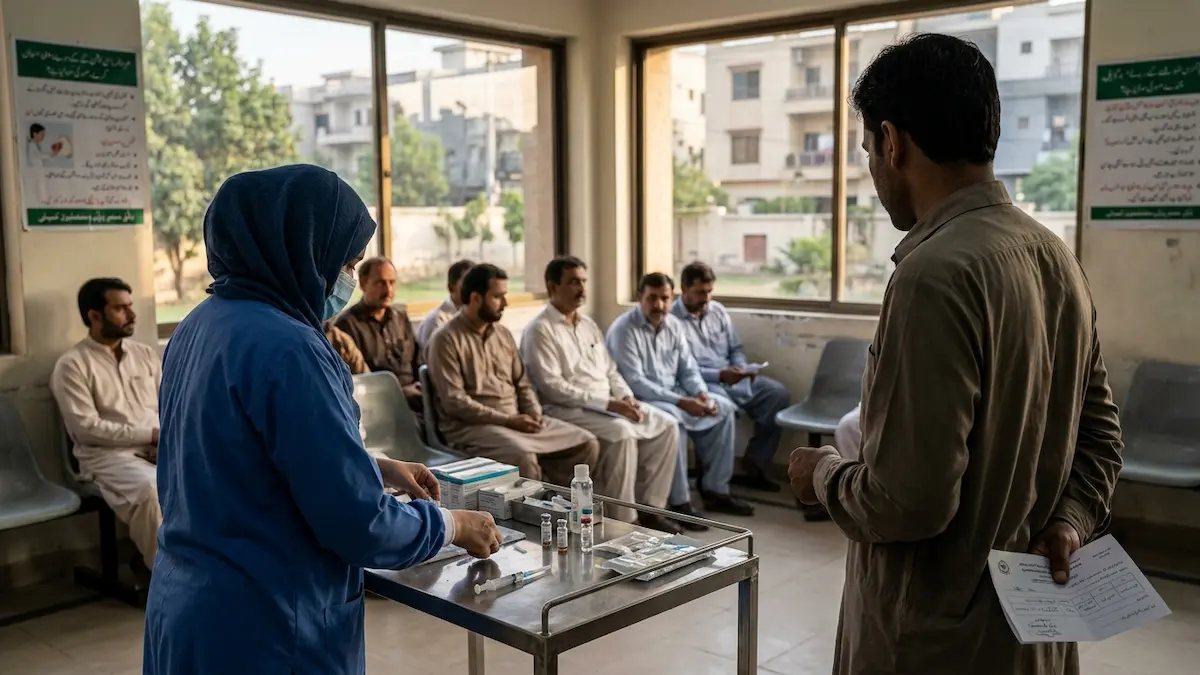
Federal Health Minister Syed Mustafa Kamal announced the Hepatitis C screening mandate on August 18, 2026, at an inauguration event in Islamabad. Employees of the Ministry of National Health Services who do not complete the required test could have their salaries stopped starting next month. The directive currently covers ministry staff in Islamabad, with letters being sent to other federal ministries to expand the requirement soon.
What the Government Has Announced: Key Measures at a Glance
The screening directive is backed by 17 designated testing points across Islamabad. Private hospitals are also being equipped with testing kits and digital equipment. People who test positive will receive free diagnosis and treatment under the national programme. This is not a standalone policy move. It is part of Pakistan’s broader 2026 healthcare workforce and public health reforms that have been building for months.
| Government Measure | Current Position |
|---|---|
| Health ministry employee screening | Mandatory in Islamabad |
| Possible salary action | Salary stoppage reported from next month for noncompliance |
| Islamabad screening points | 17 points announced |
| Private hospitals | Testing kits and digital equipment planned |
| Wider coverage | Expansion to other parts of Pakistan |
| Initial age group | People aged 12 and above |
| Treatment | Free diagnosis and treatment for people who test positive |
Who Is Affected by the Hepatitis C Screening Order?
The first group directly affected is employees of the Ministry of National Health Services based in Islamabad. Other federal ministries are next. The government is reportedly sending letters to those departments now.
What matters here is not just the requirement itself. It is how quickly departments communicate the screening locations, deadlines and procedures to their staff. Employees on approved leave or those with scheduling conflicts should contact their HR or administration office directly. Relying on social media posts or informal messages is not advised.
Why the Salary Warning Is Significant
Pakistan has run Hepatitis C awareness and treatment drives before. What makes this directive different is the administrative enforcement mechanism. Tying compliance to salary payment creates a much stronger incentive than awareness campaigns alone.
However, it is important to understand what screening actually means. A reactive initial result does not confirm a Hepatitis C infection. It flags someone for confirmatory PCR testing. According to the WHO Hepatitis C Fact Sheet, direct-acting antiviral medicines now cure more than 95 percent of infections. The pathway from screening to confirmation to treatment to cure needs to work smoothly for this programme to succeed. Employees also have a right to know how their medical information will be handled and kept confidential.
Pakistan’s Wider Hepatitis C Challenge: 164 Million People by 2030
The ministry directive is a small piece of a very large national effort. In May 2026, Pakistan and the WHO jointly launched the Prime Minister’s National Programme for the Elimination of Hepatitis C. The Islamabad phase alone targets 1.6 million people in its first six months. The national target is more than 164 million people aged 12 and above.
Pakistan carries one of the heaviest Hepatitis C burdens in the world. Over 10 million people are currently living with the virus. Around 110,000 new cases are recorded each year. The government has set 2030 as the elimination deadline. For context on what access to free treatment and testing means for ordinary Pakistanis, the Punjab Health Card programme has already opened pathways for millions to access hospital care at no cost.
What the Islamabad Programme Has Actually Achieved So Far
Programme data from August 8, 2026 shows 28,691 people screened in Islamabad against a target population of about 2.1 million. Of those screened, 2,218 returned initial positive results. Only 682 went on to receive confirmatory PCR testing, and 449 people started treatment.
These numbers reveal a critical gap. A large proportion of people with reactive initial results are not completing the follow-up steps. This gap between screening and treatment is the real challenge the national programme must solve as it expands to Punjab, Sindh, KP and Balochistan.
Why Screening Alone Is Not Enough to Eliminate Hepatitis C
A mass screening drive has four stages that must all work together. First, initial screening identifies people who may carry the virus. Second, confirmatory testing establishes whether there is an active infection. Third, treatment with antiviral medicines clears the infection. Fourth, follow-up confirms the person has been cured.
The WHO confirms that modern direct-acting antivirals cure more than 95 percent of cases. But that outcome is only possible if all four stages are completed. Tracking only the number of tests performed gives an incomplete picture. The programme should regularly publish data on confirmatory testing rates, treatment starts, treatment completions and confirmed cures.
How Hepatitis C Spreads in Pakistan: What Makes This Country Different
Hepatitis C is a bloodborne infection. It does not spread through sharing food, casual contact or sitting near an infected person. The main transmission routes in Pakistan include reused or non-sterile syringes, unscreened blood transfusions, unsafe surgical and dental procedures, and contaminated blades or cutting tools.
This matters because mass testing without addressing these transmission routes will not stop new infections. The programme needs simultaneous action on safe injection practices, blood screening standards, sterilisation in clinics and proper disposal of medical equipment. Pakistan’s healthcare professionals working in these settings are on the front line of that effort. The pathway for Pakistani nurses and healthcare workers internationally also underscores the importance of maintaining rigorous infection control standards domestically.
Six Steps Affected Employees Should Take Now
- Check the official screening notice from your department. Confirm the assigned location and deadline.
- Complete the initial test at an authorised screening point listed by your ministry or department.
- Keep proof of screening. You may need documentation to confirm compliance.
- Ask about follow-up steps if the result is reactive. A reactive result is not a confirmed diagnosis. Confirmatory PCR testing is the next step.
- Use the official treatment pathway. Free diagnosis and treatment are available under the national programme for eligible positive cases.
- Contact your HR or administration office if you are on approved leave or face scheduling problems. Do not rely on unofficial channels for deadline information.
Timeline of Pakistan’s Hepatitis C Elimination Campaign
| Date | Development |
|---|---|
| 2025 | Pakistan launched the Prime Minister’s National Programme for the Elimination of Hepatitis C |
| August 2025 | Pakistan and WHO announced stronger prevention efforts under the national programme |
| May 14, 2026 | Islamabad phase launched with a target of 1.6 million people in six months |
| July 27 to 28, 2026 | Government reaffirmed the 2030 elimination target and described Hepatitis C as a major national health challenge |
| August 18, 2026 | Health ministry employee screening directive announced in Islamabad with salary enforcement clause |
What Changed From Earlier Efforts
Earlier Hepatitis C programmes in Pakistan focused on treatment for specific groups or targeted regions. The current programme is different in both scale and approach. It aims to reach more than 164 million people through phased national implementation, with an emphasis on early detection before symptoms appear.
This matters because Hepatitis C is often silent in its early stages. Many people do not know they are infected. Left untreated, chronic infection can lead to cirrhosis and liver cancer over time. Catching cases early through population-level screening gives people access to treatment before serious damage occurs.
What Happens Next: Expansion Beyond Islamabad
The immediate focus remains completing the screening drive among health ministry employees in Islamabad. After that, coordination with other federal ministries will expand the mandatory screening requirement across the capital’s government workforce.
The larger question is how the programme scales to Khyber Pakhtunkhwa, Punjab, Sindh and Balochistan. Reaching people in smaller cities and rural areas will require mobile screening units, primary healthcare facilities and local health centres. The government must also maintain reliable supplies of testing kits, PCR equipment and antiviral medicines as the number of screened people grows rapidly.
Key Facts at a Glance
| Question | Answer |
|---|---|
| Who is affected first? | Health ministry employees in Islamabad |
| What is required? | Hepatitis C screening |
| Reported penalty | Possible salary stoppage from next month |
| Islamabad target | About 1.6 million people in the initial programme phase |
| National target | More than 164 million people |
| Target year | 2030 |
| Treatment | Free treatment under the national programme for eligible positive cases |
| Cure rate | More than 95 percent with modern antiviral treatment, according to WHO |
Frequently Asked Questions
Is Hepatitis C screening mandatory for health ministry employees?
Yes. The directive announced on August 18, 2026 makes Hepatitis C screening mandatory for employees of the Ministry of National Health Services in Islamabad. Extension to other federal ministries is being prepared.
Can a government employee’s salary be stopped for not getting screened?
According to the reported directive, employees who fail to complete mandatory Hepatitis C screening could face salary stoppage from the following month. The exact administrative procedure should be confirmed through the employee’s own department and any formal notification issued by the ministry.
Does a positive Hepatitis C screening result mean a person has the disease?
Not necessarily. An initial reactive result means the person needs confirmatory PCR testing. A positive screening result alone does not establish an active Hepatitis C infection.
Is Hepatitis C curable?
Yes. The World Health Organization confirms that modern direct-acting antiviral medicines can cure more than 95 percent of Hepatitis C cases. Free treatment is available for eligible positive cases under Pakistan’s national programme.
How does Hepatitis C spread?
Hepatitis C is a bloodborne infection. It does not spread through food, water or casual social contact. Key transmission routes in Pakistan include reused syringes, unscreened blood transfusions, unsafe surgical or dental procedures and contaminated cutting tools.
What is Pakistan’s national target for Hepatitis C screening?
The national programme aims to screen more than 164 million people aged 12 and above through phased implementation across all provinces, with 2030 set as the elimination deadline.