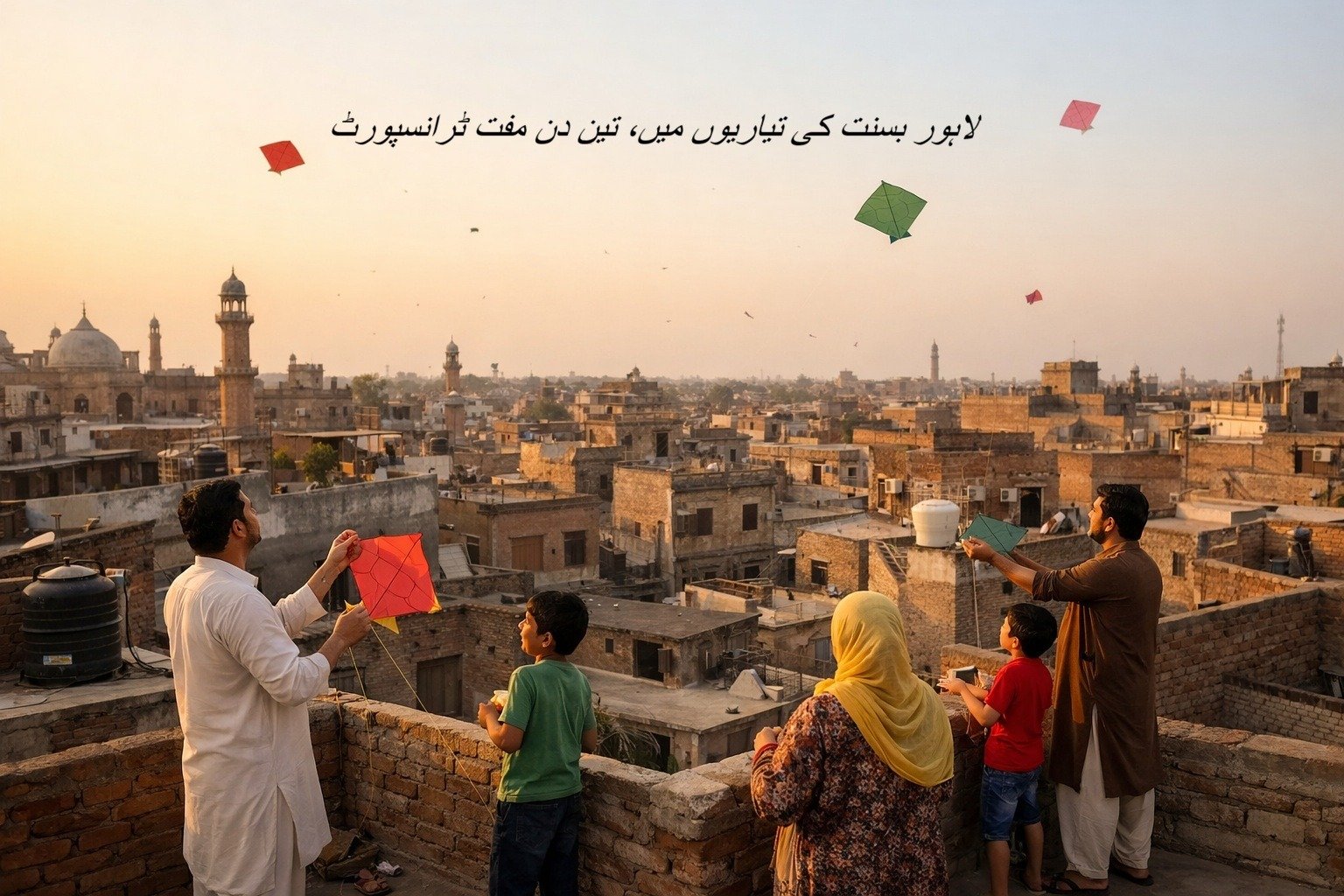
Basant in Lahore 2026: Free Transport, New Safety Rules & Everything You Need to Know
Pakistan’s most controversial festival returns with unprecedented safety measures and government support

📋 Table of Contents
After nearly two decades of bans, legal battles, and heated public debate, Basant is making an official comeback to Lahore. But here’s what most people are missing: this isn’t the same Basant you remember.
The 2026 revival comes with something unprecedented in Pakistan’s festival management history — free public transport, regulated manufacturing, and a three-day controlled window. And honestly? The transport part might be more important than the kites themselves.
Let me walk you through what’s actually happening, why it matters, and what makes this different from previous attempts.
تقریباً بیس سال کی پابندیوں، عدالتی تنازعات اور شدید عوامی بحث کے بعد، بیسنٹ ایک بار پھر باضابطہ طور پر لاہور واپس آ رہا ہے۔ لیکن اصل بات یہ ہے کہ یہ بیسنٹ ماضی جیسا نہیں ہوگا۔
2026 میں بیسنٹ کی واپسی پاکستان کی ایونٹ مینجمنٹ کی تاریخ میں ایک منفرد تجربہ ہے — مفت عوامی ٹرانسپورٹ، پتنگ سازی پر سخت ضابطے، اور صرف تین دن کی محدود اجازت۔ حقیقت یہ ہے کہ اس بار سب سے اہم چیز پتنگیں نہیں بلکہ ٹرانسپورٹ کا نظام ہے۔
آئیے جانتے ہیں کہ اس بار اصل میں کیا بدلا ہے، یہ فیصلہ کیوں اہم ہے، اور یہ کوشش ماضی کی تمام ناکام کاوشوں سے کس طرح مختلف ہے۔
🎯 Quick Facts at a Glance
- Dates: February 6-8, 2026 (three days only)
- Location: Lahore (pilot city)
- Free Transport: All government buses and registered rickshaws
- Manufacturing Start: December 30, 2025
- Scope: Controlled public event, not unrestricted festival
Official Basant Date in Pakistan: February 6-8, 2026
Let’s clear up the confusion right away. According to Punjab government administrative briefings, Basant in Lahore will officially run for three consecutive days — from February 6 through February 8, 2026.
This isn’t a vague announcement or traditional seasonal timing. It’s a fixed, government-sanctioned timeline designed to allow authorities to concentrate resources rather than maintain indefinite vigilance.
Important: This approval currently applies only to Lahore. There’s been no indication of province-wide or nationwide implementation. Think of Lahore as the test case — if things go smoothly, other cities might follow. If not, well, we know what happened last time.
The decision to limit Basant to three specific days reflects a fundamental shift in how authorities are approaching the festival. Instead of treating it as an organic cultural celebration that naturally spans weeks, they’re framing it as a managed public event with clear start and end points.
This distinction matters because it changes enforcement dynamics entirely. Police, rescue services, and municipal bodies can now plan rotations, allocate emergency resources, and coordinate inspections with precision — something that was nearly impossible when Basant had no official boundaries.
Free Transport on Basant: The Game-Changer Nobody’s Talking About
Here’s where this story gets genuinely interesting. While everyone’s debating kite flying, the Punjab government made a decision that could fundamentally change how Pakistan manages large public events: completely free public transport during all three days of Basant.
And I mean completely free. Government buses, metro services, and all registered rickshaws will operate without fares throughout the festival period in Lahore.
Why Transport Matters More Than Kites
Let me explain why this is actually brilliant. Historical emergency data from previous Basant celebrations shows something most people overlook: the majority of serious injuries didn’t happen on rooftops — they happened on roads.
Motorcycle riders were particularly vulnerable. Sharp kite strings stretched across streets at neck height caused fatal accidents year after year. Delivery workers, commuters, even children on bikes became victims of what was supposed to be a joyful celebration.
The Transport Strategy Breakdown:
- Reduces motorcycle dependency: When buses are free, people leave bikes at home
- Lowers road congestion: Fewer private vehicles mean clearer emergency routes
- Improves response times: Ambulances and rescue services can navigate faster
- Minimizes high-risk exposure: Two-wheeler riders face the greatest danger from kite strings
According to urban mobility frameworks used by Punjab’s transport department, crowd movement control represents one of the most effective tools for reducing festival-related injuries. This isn’t just good policy — it’s preventive planning applied to culture.
And here’s the kicker: this approach aligns with global best practices. Cities worldwide restrict private vehicle usage during high-risk events and expand public transport. Lahore is simply applying that logic to Basant.
| Safety Measure | Implementation | Expected Impact |
|---|---|---|
| Free Public Transport | Feb 6-8, 2026 | 30-40% reduction in motorcycle usage |
| Regulated Manufacturing | Starts Dec 30, 2025 | Elimination of dangerous string materials |
| Three-Day Limit | Strict enforcement window | Focused resource deployment |
| Mandatory Registration | All manufacturers & sellers | Accountability and traceability |
The New Safety Framework: What’s Actually Different This Time
Alright, let’s address the elephant in the room. Everyone’s wondering: if Basant couldn’t be managed before, why should we believe it’ll work now?
The answer isn’t optimism or promises. It’s structural design.
Authorities are relying on three interconnected changes that didn’t exist during previous Basant celebrations:
1. Controlled Duration Strategy
Limiting the festival to precisely three days isn’t arbitrary. It’s based on enforcement capacity analysis. Here’s what concentrated deployment allows:
- Police can work rotating 12-hour shifts without exhaustion
- Rescue services maintain full staffing throughout
- Inspectors can conduct meaningful spot checks rather than token surveillance
- Emergency rooms can prepare with additional staff and supplies
Compare that to previous years when Basant unofficially stretched for weeks, depleting resources and creating enforcement fatigue. A three-day window makes compliance measurable and violations prosecutable.
2. Supply-Side Regulation Model
This is where the government’s approach gets genuinely innovative. Instead of chasing violations after dangerous kites reach consumers, they’re regulating manufacturing at the source.
According to Punjab commerce and local government guidelines, all kite makers must now register, use approved materials, and maintain sales records. The objective is to stop hazardous strings before they enter circulation.
What’s Banned: Metal-coated strings, glass-coated strings (commonly called “dor”), and any cutting materials designed to sever competitor kites. These materials caused the majority of fatal accidents in previous years.
3. Mobility Management Infrastructure
We’ve already covered free transport, but there’s more to the mobility plan. Traffic routing, parking restrictions, and designated celebration zones are all being coordinated to minimize chaos.
This multi-agency approach — combining transport, police, and municipal authorities — represents the first time Basant is being treated as a logistics challenge rather than just a cultural event.

Lahore’s historic rooftops will once again host kite flyers under the new controlled framework
Kite Manufacturing Begins December 30: Economic Relief With Accountability
Here’s something worth understanding: before the ban, Basant supported thousands of families in Lahore’s inner-city areas. Kite-making wasn’t just a business — it was seasonal livelihood for entire neighborhoods.
The prolonged suspension devastated these micro-economies. Skilled artisans had to find alternative work. Supply chains collapsed. An informal industry with deep cultural roots simply vanished overnight.
The decision to permit manufacturing from December 30 — nearly five weeks before the festival — signals that authorities recognize this economic dimension. But it comes with non-negotiable conditions.
Manufacturing Requirements for 2026:
- Mandatory government registration before operations begin
- Use of approved materials only (cotton string, safe dyes)
- Maintenance of production and sales records
- Clear accountability chains for violations
- Surprise inspections and quality audits
This formalization approach balances economic relief with public safety. The government isn’t just saying “here, make kites again.” They’re saying “make kites, but you’re responsible for what you produce.”
If unsafe materials are found during inspections, manufacturers face penalties and license revocation. This creates incentive for compliance beyond just avoiding fines — businesses that follow rules can operate year after year, building sustainable income.
It’s a model that could theoretically work. The question is whether enforcement capacity matches regulatory ambition.
Why This Matters: Beyond Kites and Celebration
Let’s zoom out for a moment. The return of Basant in Lahore 2026 matters far beyond cultural nostalgia or economic relief. This is effectively a national experiment in governance.
If this controlled revival succeeds, it could influence:
- Other banned cultural events: Several traditional celebrations remain restricted across Pakistan due to safety concerns
- Political rally management: Crowd control techniques tested during Basant could apply to large political gatherings
- Religious procession safety: Transport and emergency response protocols might transfer to Muharram and other processions
- Public trust in regulation: Demonstrating that rules work better than blanket bans could shift how citizens view governance
In effect, Basant 2026 is Pakistan testing whether it can manage large civilian events without resorting to prohibition. That’s a significant question with implications extending well beyond Lahore’s rooftops.
Expert Perspective: From a transport safety standpoint, Lahore’s model aligns with international standards. Cities from Barcelona to Rio de Janeiro restrict private mobility during festivals. If executed properly, this approach could become a blueprint for event management nationwide.
Skepticism and Controversy: The Concerns That Remain
Now, let’s be realistic. Not everyone is convinced this will work, and their concerns aren’t baseless.
Critics point to several legitimate challenges:
Enforcement Capacity Questions
Pakistan’s track record with consistent enforcement is… mixed, to put it diplomatically. Will inspectors actually show up to manufacturing facilities? Will police maintain vigilance for three full days? Will accountability mechanisms function when violations occur?
These aren’t cynical questions — they’re based on past experience with similar initiatives that started strong but faltered during implementation.
Informal Market Concerns
Even with registration requirements, informal markets are notoriously difficult to control. What happens to unregistered sellers operating outside official channels? How do authorities monitor neighborhood-level transactions?
There’s a very real possibility that dangerous kite strings will still circulate despite regulations, especially in areas with less oversight.
Rooftop Overcrowding
While transport planning addresses road safety, rooftop safety remains a concern. Buildings in older Lahore areas weren’t designed for festival crowds. Structural failures, falls, and crowding injuries have occurred in past celebrations.
What’s Changed: Authorities now have clearly defined roles. Transport departments, district administrations, and commerce authorities each have specific responsibilities. If something goes wrong, accountability is easier to trace — which itself might improve compliance.
The skepticism is justified. But what’s different is that responsibility is no longer ambiguous. Success or failure will be measurable, and accountability mechanisms exist on paper. Whether they function in practice is what we’ll find out in February.
What Happens Next? Timeline and Expectations
So what should people expect in the coming months? Here’s a realistic timeline:
📅 Key Dates to Watch:
- December 30, 2025: Registered kite manufacturing begins
- January 2026: First wave of inspections and compliance checks
- Late January: Transport logistics finalized, emergency protocols tested
- February 1-5: Public awareness campaigns, safety messaging intensifies
- February 6-8: Basant festival days with free transport
- February 9 onwards: Assessment phase, data collection on incidents
If incidents remain low and enforcement holds, expect gradual expansion. Other cities might receive approval for 2027. Manufacturing windows could extend. Regulations might adjust based on lessons learned.
If serious accidents occur or enforcement collapses, authorities will face immense pressure to reimpose bans. The stakes are genuinely high.
Public cooperation will be crucial. Authorities can regulate manufacturers and manage transport, but they can’t monitor every rooftop or chase every kite seller. Community buy-in matters.
Frequently Asked Questions About Basant in Lahore 2026
Final Perspective: A Controlled Comeback, Not a Full Revival
Let’s be clear about what Basant in Lahore 2026 actually represents. This isn’t a nostalgic return to the way things were. It’s not an unrestricted celebration where the entire city flies kites for weeks on end.
What we’re seeing is a policy experiment — a carefully structured attempt to blend cultural celebration with modern safety management, economic relief with regulatory oversight, and public joy with government accountability.
The free transport initiative alone represents innovative thinking in Pakistani governance. The manufacturing controls show willingness to formalize informal economies. The three-day limit demonstrates understanding of enforcement capacity.
Whether these measures succeed depends on execution, not theory. Paper policies need ground-level implementation. Registered manufacturers need actual oversight. Free buses need to actually run on time.
But here’s what matters most: authorities are testing regulation as an alternative to prohibition. They’re asking whether smart management can preserve culture without compromising safety.
That question deserves serious attention. If Lahore’s experiment works, it could change how Pakistan approaches not just festivals, but public events broadly. If it fails, we’ll likely see a return to blanket bans and lost opportunities.
For now, the confirmed dates, free transport system, and regulated manufacturing represent the most structured attempt to revive Basant in Pakistan’s history. February 2026 will reveal whether structure is enough.
And that’s precisely why this story matters beyond kites and celebration.