Pakistan’s airports have been a source of frustration for years. Long queues. Crowded terminals. No one to help. That may finally be changing.
Islamabad International Airport is testing a new premium meet-and-assist service that could reshape how passengers move through one of Pakistan’s busiest airports. I covered Pakistan’s broader airport queue problem earlier. This development is the next step in that story.
What Is Islamabad Airport’s New Premium Service?
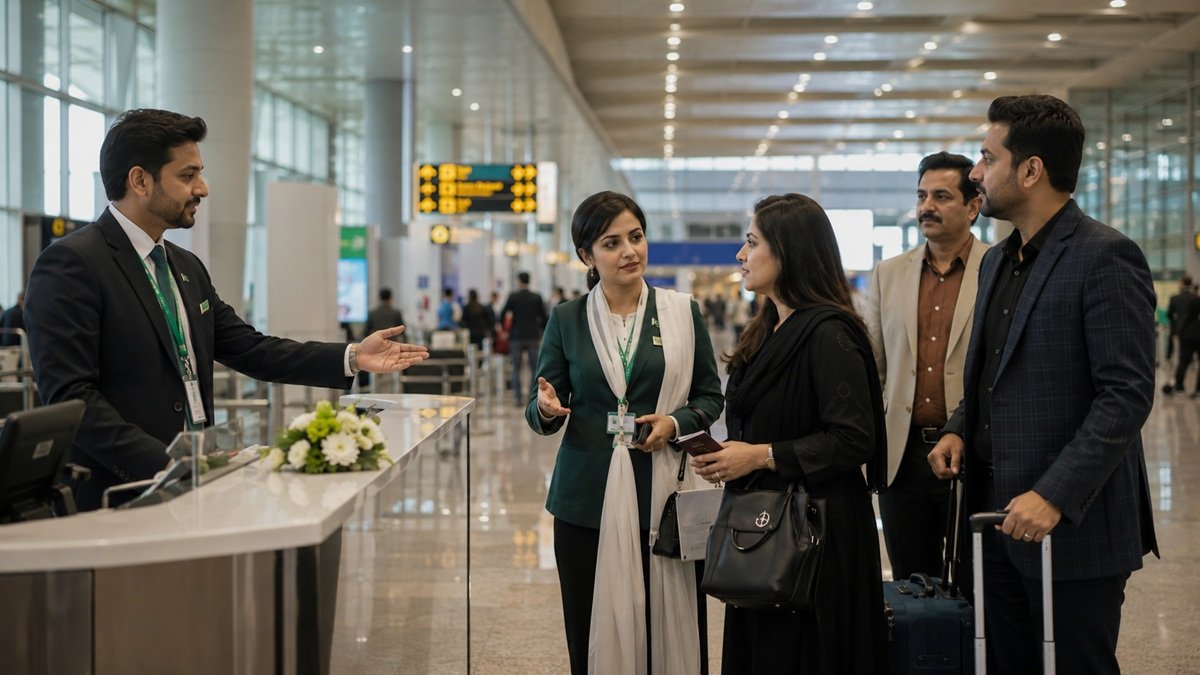
The proposed service is a meet-and-assist style airport support system. It is designed to help passengers move through airport processes more easily.
In practical terms, travelers may receive help with:
- Airport navigation and terminal guidance
- Luggage coordination and handling
- Arrival and departure handling support
- Pickup guidance outside the terminal
- Faster movement through airport processes
This kind of airport assistance already exists at major international hubs. Pakistan is now entering that same space. According to the Pakistan Civil Aviation Authority (PCAA), Islamabad International Airport is among the country’s largest and most modern aviation facilities, handling millions of domestic and international passengers annually.
| Service Area | Passenger Benefit |
|---|---|
| Meet-and-assist support | Easier movement inside airport |
| Luggage handling help | Reduced travel stress |
| Terminal guidance | Better airport navigation |
| Personalized assistance | Less confusion for first-time flyers |
| Family travel support | Easier movement with children or elderly passengers |

Why This Matters for Travelers in Pakistan
Airports shape first impressions. For overseas Pakistanis and foreign visitors, the airport is often the first direct experience of the country.
Pakistani airports have long struggled with weak customer service, crowded terminals, slow passenger movement, and transport confusion at exits. In my experience covering travel in Pakistan, even small improvements at the airport level create a noticeably different experience for families and first-time flyers.
According to the International Air Transport Association (IATA), airports worldwide are investing heavily in passenger experience services because travelers now value speed, convenience, and digital support more than ever before. Pakistan cannot afford to stay behind.
How Premium Airport Assistance Usually Works
Most premium airport services follow a clear, four-step process.
Step 1: Pre-Booking
Passengers reserve the service before their flight. This is done through an online system, airline partner, or travel agency.
Step 2: Airport Reception
An airport representative receives the passenger at a designated meeting point.
Step 3: Guided Movement
The passenger receives help with check-in, boarding procedures, terminal navigation, luggage movement, and airport coordination.
Step 4: Exit or Pickup Assistance
For arriving passengers, staff may also help coordinate transport or pickup arrangements outside the terminal.
According to Hamad International Airport, premium passenger services have become a major part of airport operations across the Middle East. Islamabad is now following that direction.
Who May Benefit the Most?
Not every passenger will need premium airport support. But several groups could see a real difference.
| Passenger Group | Why It Matters |
|---|---|
| Overseas Pakistanis | Easier family arrivals during Eid and summer |
| Elderly travelers | Reduced walking stress and navigation confusion |
| Business travelers | Faster movement and time saved |
| Families with children | Better luggage handling during busy trips |
| First-time flyers | Less confusion at every stage |
In my observation of Pakistan’s travel market, passengers are becoming more willing to pay extra when a service genuinely removes stress from difficult experiences. Airports remain one of the biggest stress points.
Pakistan’s Travel Economy Is Changing
The bigger story here is not the airport service itself. It is what it reflects about changing consumer behavior in Pakistan.
People increasingly pay for services that reduce uncertainty and save time. That trend is already visible in ride-hailing apps, food delivery platforms, digital banking, and online shopping. Airport assistance fits directly into this growing convenience economy.
This shift is especially visible among middle-income and overseas Pakistani travelers who prioritize comfort during long international journeys. If the service is priced right, adoption could be faster than expected. You can also see how Pakistan’s passport access trends connect to the same shift in how Pakistanis travel internationally.
Comparison With Gulf Airports
Travelers who have passed through Dubai, Doha, or Abu Dhabi already understand how premium airport systems work.
Major Gulf airports now offer concierge-style support, priority handling, luxury lounges, chauffeur-linked transport, and personalized airport assistance. Dubai Airports promotes premium passenger experience as part of its international travel strategy. Hamad International Airport in Doha has repeatedly ranked among the world’s best for passenger experience.
Pakistan’s airports still operate behind those standards. But Islamabad’s latest move signals that airport authorities are beginning to treat passenger convenience as a business opportunity — not just a public utility. That change could influence national airport policy for years ahead.
Could Lahore and Karachi Follow?
If Islamabad’s premium service proves commercially successful, similar systems may later expand to Jinnah International Airport in Karachi and Allama Iqbal International Airport in Lahore.
Karachi handles major business travel. Lahore sees heavy family and overseas passenger movement. Demand for smoother airport services may already exist in both cities. Private operators may also become more interested in airport-linked travel services if Islamabad’s model attracts positive feedback.
Those watching the broader Gulf residency and travel market will note that services like this are part of why airports in the region attract more repeat travelers. See how Dubai’s visa and residency policies are shaping travel behavior for Pakistanis abroad.
Important Concerns Passengers Still Have
Four Questions That Need Answers
- Pricing Transparency: Passengers will expect clear pricing without hidden charges.
- Reliable Service: Premium services only work when staff training and execution remain consistent.
- Genuine Time Savings: Travelers will judge the service based on whether it actually reduces stress.
- Accessibility: If costs are too high, the service may only serve a small segment of travelers.
Pakistan’s service industry often launches strong ideas but struggles with consistency later. Reliability may become the deciding factor for long-term success.
What Happens Next?
| Area to Watch | Why It Matters |
|---|---|
| Official launch details | Explains actual service structure and scope |
| Pricing announcement | Determines affordability for most travelers |
| Passenger feedback | Shows whether market acceptance is strong |
| Expansion plans | Indicates future airport upgrades nationally |
| Private sector involvement | May attract investment and competition |
Final Takeaway
Islamabad Airport’s new premium passenger assistance service may look like a small operational upgrade. It is actually part of a much bigger shift in Pakistan’s travel economy.
Passengers increasingly want convenience, comfort, and predictable service. Airports are slowly responding. Whether this becomes a successful long-term improvement will depend on pricing, service quality, and reliability. The direction itself, however, is clear. Pakistan’s aviation sector is moving toward a more modern, passenger-focused experience. The real test starts when the doors open and real travelers walk through.
Frequently Asked Questions
What is Islamabad Airport’s new premium service?
It is a meet-and-assist style airport support service designed to help passengers move more smoothly through arrivals and departures at Islamabad International Airport.
Who is most likely to use the service?
Business travelers, overseas Pakistanis, elderly passengers, and families with children are expected to benefit the most from this service.
Will the service reduce airport waiting times?
The goal is smoother passenger movement and reduced confusion. Exact time savings will depend on operational quality once the service fully launches.
Is this common internationally?
Yes. Similar airport assistance services already operate at major airports across the Gulf region and Europe, including Dubai, Doha, and Abu Dhabi.
Could other Pakistani airports launch similar systems?
If Islamabad’s model performs well, airports in Karachi and Lahore could eventually adopt similar passenger support services.
Is this service only for premium or business class passengers?
Not necessarily. While pricing details are still emerging, the service may be available to any passenger who books it regardless of ticket class. Affordability will be a key factor in how widely it is adopted.