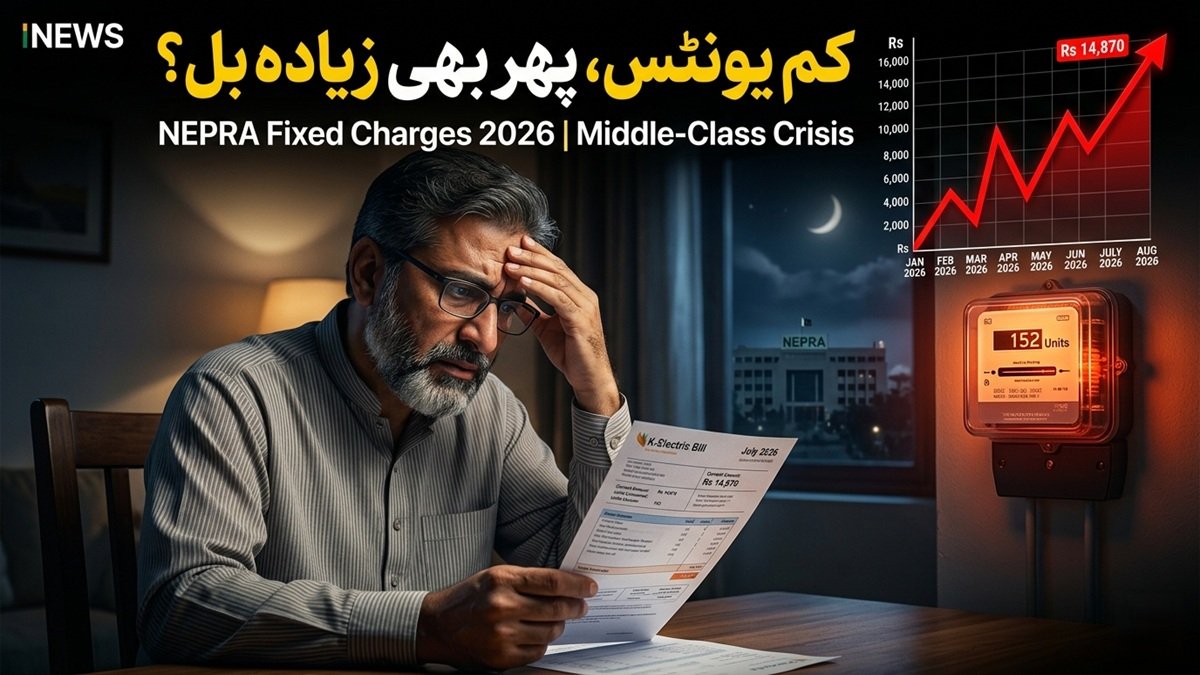
If your electricity usage dropped in 2026 but your bill still went up, you are not imagining it. Pakistan’s latest tariff change has altered a basic rule that millions of families relied on for years: use fewer units, pay a lower bill. That rule still matters. But it no longer tells the full story.
Under NEPRA’s February 2026 tariff revision, many domestic consumers now face fixed monthly charges even at lower usage levels. Fuel cost adjustments, taxes, and connection-related factors can still push the final bill higher than expected. That means some families may use less electricity than before and still pay more.
What Changed in NEPRA’s 2026 Electricity Tariff?
The biggest change is simple. Fixed charges are now hitting more residential consumers than before.
Previously, fixed charges were mostly tied to higher-use or certain non-protected categories. But after the NEPRA February 2026 tariff update, many protected and non-protected domestic consumers may now pay fixed monthly charges depending on their category, sanctioned load, and billing setup.
This is also connected to broader mini-budget and IMF-linked reforms that have been reshaping Pakistan’s utility cost structure. It does not happen in isolation.
Reported Domestic Fixed-Charge Ranges
According to Daily Times and ProPakistani coverage of the revised Schedule of Tariff:
| Consumer Category | Usage Slab | Reported Fixed Charge |
|---|---|---|
| Lifeline (exempt) | Up to 50 units / 51–100 units | No fixed charge |
| Protected | 1–100 units | ~Rs 200/month |
| Protected | 101–200 units | ~Rs 300/month |
| Non-protected (lower slabs) | Varies | ~Rs 275 to Rs 675/month |
| Higher slabs | Varies by category | Larger fixed costs apply |

Are Lifeline Consumers Exempt?
In most reported summaries, lifeline consumers remain protected. Users in the lowest domestic slabs (commonly up to 50 units and 51–100 units in lifeline categories) are generally still exempt from these new fixed charges, while continuing to pay the lower lifeline unit rates of Rs 3.95/unit and Rs 7.74/unit with no fixed charge.
But here is the key distinction many people miss.
Many people confuse lifeline with protected. They are not the same thing.
- Lifeline users are the most protected low-consumption category.
- Protected users can still be low-usage consumers but may not qualify for the same exemption.
So yes, a household using relatively low units may still get hit with a fixed charge if it is protected but not lifeline, or if the meter or load category places it outside the exempt group. That is one of the biggest reasons this tariff change is causing so much confusion.
Why Low-Usage Homes Can Still Get a Bigger Bill
This is the part most consumers need to understand. A lower unit count does not guarantee a lower final bill anymore. The bill now has more non-usage pressure built into it.
1. Fixed Charges May Apply Even at Lower Usage
Even if your units drop, a fixed monthly charge can still be added. That immediately reduces the benefit of saving electricity.
2. Fuel Cost Adjustment (FCA) Can Change Monthly
Your base tariff is only one part of the bill. The Power Division (Ministry of Energy) has publicly clarified that tariff relief and FCA are different components. FCA can move up or down month to month independent of the base rate.
3. Taxes and Duties Still Stack on Top
Electricity duty, sales tax, TV fee (where applicable), and other line items can still inflate the final amount considerably.
4. Meter Setup Can Work Against You
In some cases, the amount on your bill depends more on your connection structure than your actual usage. This is especially true if you have a three-phase meter, a TOU or peak-hour meter, a higher sanctioned load than you actually need, or older wiring under an old connection category.
Your connection profile may now matter almost as much as your unit consumption.
Can You Reduce Fixed Charges by Changing Meter Type or Load?
Sometimes yes. But not always. It depends on meter type, single-phase or three-phase setup, sanctioned load, wiring condition, safety compliance, and your DISCO’s inspection and approval rules.
Some consumers may be able to lower future bill pressure by requesting a sanctioned load review, asking whether a single-phase conversion is possible, or confirming whether their meter category still matches actual usage. However, your DISCO may reject changes due to building wiring limits, safety standards, transformer constraints, load requirement rules, or local inspection policy.
Are Solar Users Also Affected in 2026?
Yes. Many solar users can still feel the impact. Even if you have rooftop solar, your bill may still stay higher than expected. This is largely because of NEPRA’s new Prosumer Regulations 2026, which took effect from February 9, 2026, and significantly changed how exported solar units are valued. New prosumers are now compensated at approximately Rs 11 per unit for exported electricity, while they pay full retail rates of Rs 40 to Rs 60 per unit for grid imports.
What This Means for Solar Owners
- Fixed charges can still remain on your bill
- Grid imports still cost full retail rates
- Export economics have become far less attractive for new connections
- Battery-backed self-consumption is now more valuable than pure export
- Users who consume more solar power directly during the day are better protected from rising costs
Important note: Solar policy details have been heavily debated, especially around new vs existing prosumers. If you are a solar user, check your latest net metering or prosumer agreement status directly with your DISCO or through official NEPRA notifications before making any financial decision.
You can also read more about Pakistan’s energy-related pressures in our coverage of petrol price movements in April 2026 and how fuel costs continue to shape household spending.
Did Industry Get Cheaper Power While Homes Face More Pressure?
Broadly, yes. That is how many consumers are reading the policy.
In February 2026, industrial electricity tariffs were officially reduced by up to Rs 4.58 per unit, following the NEPRA ruling dated February 11, 2026. The revision applies across industrial categories and continues through December 2026.
| Industrial Category | Previous Rate | New Rate (Feb 2026) | Reduction |
|---|---|---|---|
| B1 (up to 25 kW) | Rs 30.80/unit | Rs 26.23/unit | ~Rs 4.57/unit |
| B2 (25–500 kW) | Rs 30.73/unit | Rs 26.16/unit | ~Rs 4.57/unit |
| B3 (11–33 kV) | Rs 31/unit | Rs 27/unit | ~Rs 4/unit |
| B4 (66–132 kV+) | Rs 30.43/unit | Rs 26.43/unit | ~Rs 4/unit |
At the same time, fixed charges for many residential users were expanded. That has created a strong public perception that some cost burden has shifted from industry toward domestic consumers. That perception is a major reason this story resonates so strongly with ordinary households across Pakistan.
For additional context on how Pakistan’s economic and energy policies interconnect, see our earlier report on Pakistan’s fuel crisis and petrol price surge.
5 Things to Check on Your Electricity Bill Right Now
- Check if you are lifeline, protected, or non-protected. Do not assume low usage automatically means full exemption from fixed charges.
- Find the fixed charges line on your bill. Compare it with last month’s bill. Even a small increase here can cancel out unit savings.
- Check your sanctioned load. If it is higher than what your home actually needs, you may be carrying unnecessary cost risk.
- Check whether you have single-phase, three-phase, or TOU. This can directly change how charges are applied.
- Separate base tariff from FCA and taxes. A “unit rate drop” in the headlines does not always mean your final bill will fall.
Pakistan is also investing heavily in infrastructure. You can read about the 3 new motorway projects that aim to boost connectivity even as energy costs remain a challenge for households.
Final Take: The Old Bill-Saving Rule Is No Longer Enough
Pakistan’s 2026 electricity tariff change is not just a routine update. It changes how people need to read their bills.
Frequently Asked Questions
Under NEPRA’s February 2026 tariff revision, many domestic consumers now face fixed monthly charges regardless of unit consumption. Even if your usage dropped, a fixed charge plus fuel cost adjustment (FCA) and taxes can still push the final bill higher.
Yes. Lifeline consumers using up to 50 units and 51–100 units continue to pay Rs 3.95 and Rs 7.74 per unit respectively with no fixed charge. However, protected consumers who fall outside the lifeline category may still face fixed charges.
Protected users (1–100 units) face around Rs 200, protected users (101–200 units) around Rs 300, and non-protected lower-slab consumers roughly Rs 275 to Rs 675 per month. Higher slabs may face larger fixed costs depending on meter and load category.
Lifeline consumers are the most protected low-consumption category and are generally exempt from fixed charges. Protected consumers use relatively low units but may not qualify for the same exemption if their meter or load category places them outside the lifeline group.
Industrial tariffs were reduced by up to Rs 4.58 per unit in February 2026 following a NEPRA ruling. The cuts apply to all distribution companies including K-Electric and remain in effect until December 2026.
Sometimes yes, but not always. It depends on your current connection type, wiring condition, DISCO policy, and safety compliance. Always ask your DISCO in writing before spending money on any electrical changes.
Solar users can still face fixed charges and high grid import rates. Under the new Prosumer Regulations 2026, new connections are compensated at roughly Rs 11 per unit for exports while paying Rs 40–60 per unit for grid imports. Battery self-consumption is now more economical than relying on net metering exports.