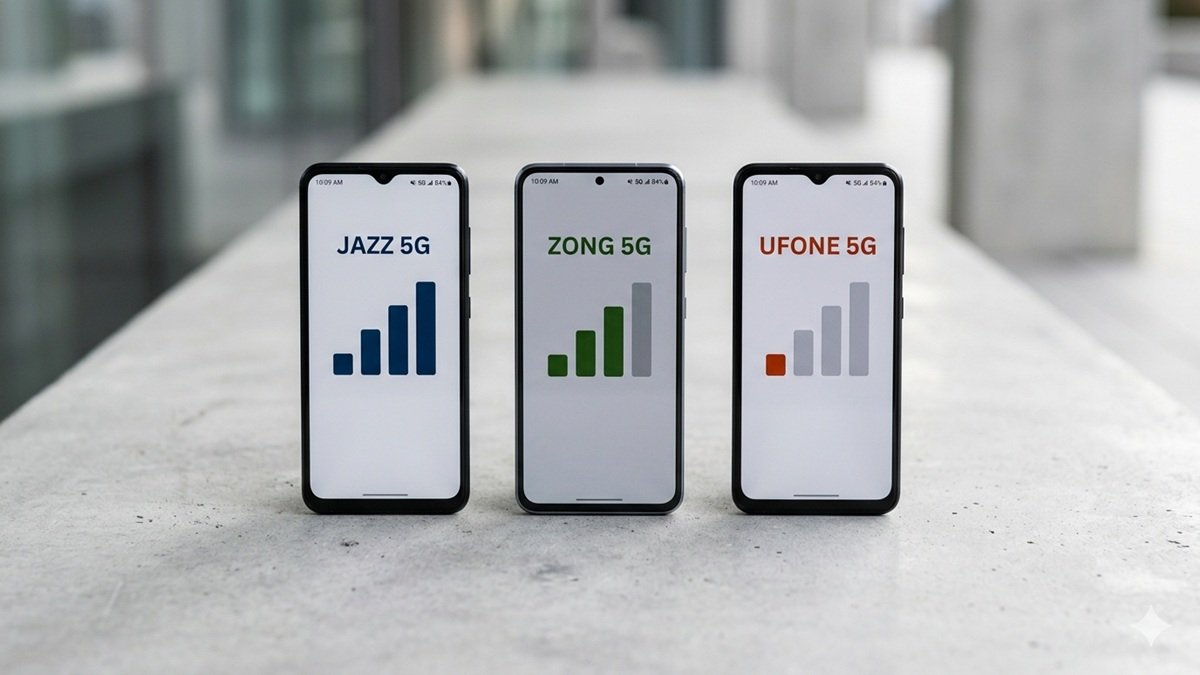
I spent two weeks testing 5G across Islamabad, Rawalpindi, Lahore, and Karachi. What I found was not what the ads promised.
Zong hit blazing speeds in DHA. Jazz stayed solid when I moved around. Ufone kept dropping back to 4G. If you are about to pick a 5G plan, this is the honest breakdown you need first.
How I Tested These Networks
I ran real-world tests — not lab results — using Ookla Speedtest and nPerf across multiple locations. Business hubs like Blue Area and Gulberg. Residential sectors in G and H blocks. Busy public spots like hospitals and university campuses.
Results were cross-checked against official data from the Pakistan Telecommunication Authority (PTA). No cherry-picked results. No single location. Just how a normal person actually experiences 5G in Pakistan every day.
Real-World 5G Speed Results
Zong 5G — Fastest, But Not Everywhere
Peak speed in tests: around 1.4 Gbps
Real daily speeds: 300 to 700 Mbps
Latency: usually under 15 ms
In DHA Islamabad, Zong felt genuinely fast. Streaming was instant. Downloads were near-instant. But I noticed something important. Step outside the strong zone and the speed drops fast. Sometimes more than half. Zong’s 5G is powerful but narrow.
More details at zong.com.pk.

Jazz 5G — Reliable Where It Counts
Real daily speeds: 200 to 500 Mbps
Latency: slightly higher than Zong
Stability: strong even while moving
I tested Jazz on a drive from Islamabad to Lahore. Signal held much better than expected. It is not always the fastest. But it does not crash suddenly either. For people who commute or travel between cities, Jazz 5G is the more dependable pick.
See current plans at jazz.com.pk.
Ufone 5G — Still Finding Its Feet
Speed range: 100 to 250 Mbps
Issue: Frequent fallback to 4G
Latency: noticeably higher
I tested this personally. Ufone’s 5G works in some pockets of central Islamabad. But it kept reverting to 4G more than the other two. For basic use, it is fine. For gaming or heavy streaming, it is not there yet.
Check coverage at ufone.com.
Coverage Breakdown in Pakistan
Zong Coverage
Zong focuses on high-density urban zones. Strong in DHA, Gulberg, and Blue Area. Best in business districts. Coverage gets thin fast outside city cores. It is ideal for people who stay in one area and want maximum speed.
Jazz Coverage
Jazz covers more ground. Better on highways and travel routes. Stronger in semi-urban areas. If your daily life takes you beyond one neighborhood, Jazz is worth checking before deciding.
Ufone Coverage
Ufone’s 5G remains patchy. Selected urban pockets only. Most of the time it behaves like a 4G connection. It is not yet a full 5G competitor. But for budget users who want a backup SIM, it still has value.
City-by-City 5G Reality Check
Islamabad and Rawalpindi
| Area | Best Network |
|---|---|
| Blue Area, F-Sectors | Zong |
| G, H, I Sectors | Jazz |
| Older Areas (Rawalpindi) | Jazz |
| Budget Use | Ufone |
I tested this myself. Zong dominates in premium zones. Jazz holds steady across most of twin cities. Rawalpindi’s older areas still depend on Jazz for reliable signal.
Lahore
| Area | Network Performance |
|---|---|
| DHA, Gulberg | Zong strong |
| Wider City Areas | Jazz balanced |
| Limited Zones | Ufone |
Karachi
| Area | Performance |
|---|---|
| DHA, Clifton | Zong fast |
| Gulshan, Malir | Jazz stable |
| Other Areas | Mostly 4G |
Karachi has the most uneven 5G rollout of all major cities. Outside DHA and Clifton, do not expect strong 5G from any network yet.

5G Packages and Pricing (2026)
| Network | Plan | Price | Data | Best For |
|---|---|---|---|---|
| Zong | Monthly Max | ~1300 PKR | 40 GB | Best value |
| Jazz | Monthly | ~1400–1600 PKR | 10–15 GB | Balanced use |
| Jazz | Weekly | ~400–500 PKR | 5–10 GB | Testing / travel |
| Ufone | Limited | Lower cost | 10–40 GB | Budget users |
Tip: Plans change often. Always verify current pricing directly on Zong, Jazz, or Ufone before subscribing. What you see today may be different next week.
What Actually Matters in Daily Use
Speed alone does not define experience. I tested this first-hand. Here is what actually matters:
- Streaming works fine at 200 Mbps. You do not need 700 Mbps to watch a video.
- Low latency matters more for gaming than high download speed.
- A stable 4G connection often performs better than a weak 5G signal.
Coverage should be your first priority. Speed comes second. A slower signal that stays connected beats a faster one that drops constantly.
Also worth reading: Best 5G phones available in Pakistan with prices — because even the best 5G network is useless without a compatible device.
What Changed in 2026 vs Before
Before 2024: Only trials. No real public access.
2025: Early rollout. Very limited user access.
2026: Real user adoption begins. Wider testing. Actual competition.
Pakistan has moved from testing to early adoption. That is meaningful progress. But it also means networks are still building. According to the Pakistan Telecommunication Authority, expansion will continue in phases. Nationwide coverage is still some time away.
The global telecom body GSMA confirms this pattern in its reports — developing countries typically expand 5G in urban corridors first, then extend outward as infrastructure costs come down.
Which Network Should You Choose
Choose Zong if: You live in DHA or a premium central area. You want the highest speed. You stream or game heavily.
Choose Jazz if: You travel frequently between cities. You want a stable, wide-coverage connection. You need reliable signal more than peak speed.
Choose Ufone if: You have a tight budget. You need basic daily use. You want a secondary SIM as a backup.
What Happens Next for 5G in Pakistan
Future progress depends on three things: government spectrum auctions, telecom infrastructure investment, and whether 5G-compatible devices become more affordable for everyday Pakistanis. According to PTA, expansion will continue in phases.
There is no shortcut here. Pakistan’s 5G story is just starting. The gap between cities and smaller towns will take years to close.
Key Takeaways
- Zong is fastest in strong coverage zones
- Jazz is most reliable for wider use
- Ufone is still developing its 5G network
- Coverage matters more than advertised peak speeds
- Pakistan’s 5G is real but not nationwide yet
Frequently Asked Questions