
Pakistan’s road network has a big problem. Fast motorway travel often ends suddenly. Then drivers are pushed onto slow, crowded roads. Three new projects in 2026 could finally fix that. The M-6, M-12, and the Faisalabad–Lahore corridor are the routes to watch. If these move on schedule, millions of drivers could save hours every trip.
Why Pakistan’s Motorway Push Matters in 2026
Pakistan already has strong motorway sections. But many long-distance trips still break down. Fast roads end. Drivers move back to slow, mixed-traffic routes. That creates real problems.
- Hours of extra travel time
- More fuel burned per trip
- Driver fatigue on long routes
- Freight delays and cost increases
- Higher risk on older highways
So 2026 is not just about building more roads. It is about closing the gaps. Official statements from the Communications Ministry and the National Highway Authority (NHA) confirm this. Communications Minister Abdul Aleem Khan said the government wants to build for the next 30 years. Not just for today.
If you are thinking about fuel costs with today’s road conditions, our earlier piece on hybrid cars under 5 million shows why many Pakistani drivers are already changing how they travel.
Quick Summary: 3 Projects That Could Change Travel Time
| Project | 2026 Status | Why It Matters | Possible Travel Impact |
|---|---|---|---|
| M-6 Sukkur–Hyderabad | Priority project; construction targeted May 2026 | Closes a major Sindh gap in north-south chain | 6–8 hrs could drop to ~3–3.5 hrs |
| M-12 Sialkot–Kharian | Under construction; upgraded to six lanes | Stronger industrial and freight access in north Punjab | Trip could move closer to 45–60 mins |
| Faisalabad–Lahore Corridor | Capacity relief; M-4 widening in development | Better reliability in central Punjab daily travel | Consistently 1.5–2 hrs instead of 3+ hrs |
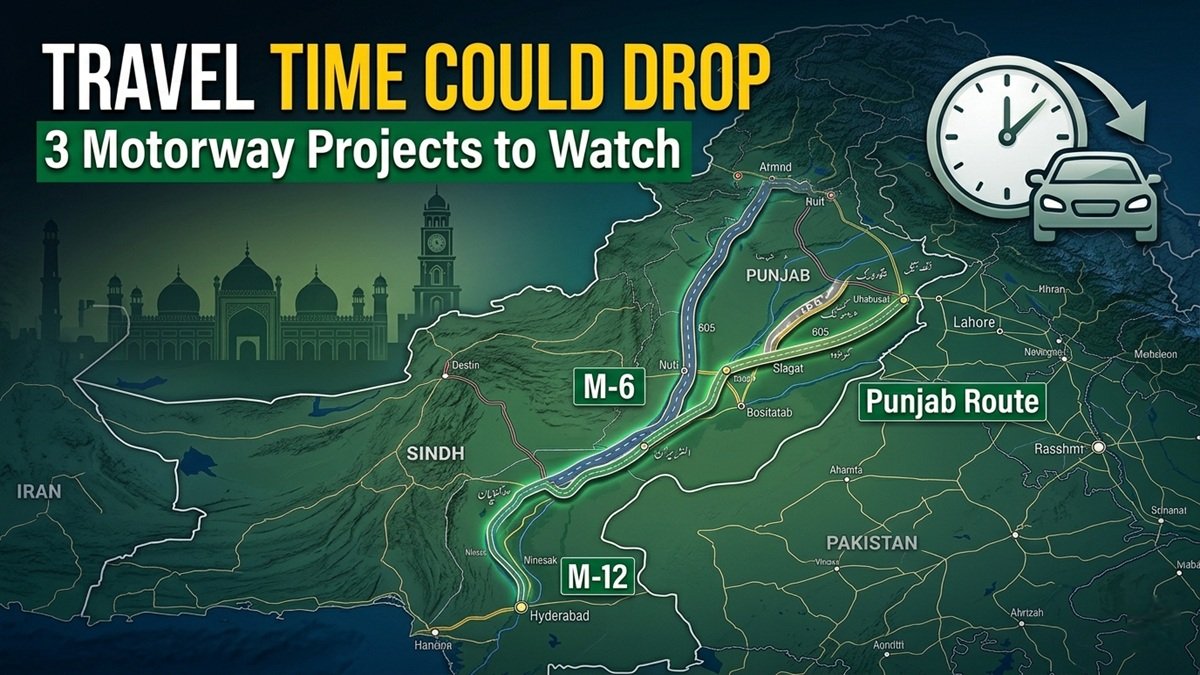
1) M-6 Sukkur–Hyderabad: The Most Important Missing Link
What is happening in 2026?
After years of delays, the M-6 Sukkur–Hyderabad Motorway is back at the center of Pakistan’s road strategy. Radio Pakistan reported on 10 February 2026 that Minister Abdul Aleem Khan confirmed construction starts in May 2026. It will run under a public-private partnership (PPP) model.
That signal matters because the Islamic Development Bank (IsDB) already approved US$475 million in financing for M-6 in September 2025. Procurement notices have been published. That is a stronger signal than political announcements alone.
M-6 connects three critical points. M-9 near Karachi at the south. M-6 in the middle. M-5 toward Multan in the north. Together, they fix Pakistan’s biggest north-south transport break.
Real impact for drivers
- Today: Sukkur to Hyderabad takes 6 to 8 hours on mixed traffic roads
- After M-6: Same trip could take 3 to 3.5 hours
- That is 2.5 to 4 hours saved per journey
- Better truck movement from Karachi port
- More reliable family travel across Sindh
2) M-12 Sialkot–Kharian: A Bigger Freight Route for North Punjab
What changed?
The M-12 Sialkot–Kharian Motorway is now a six-lane project. It was originally four lanes. Radio Pakistan reported in February 2026 that Minister Abdul Aleem Khan confirmed the upgrade. The NHA’s PPP project list shows M-12 as a 69 km corridor already under construction.
This is a major policy shift. It means the government is planning for future freight. Not just today’s traffic numbers.
Why it matters beyond Sialkot
Pakistan’s road users are already shifting their habits due to fuel and congestion pressures. Better freight roads make that transition even more important. Sialkot is one of Pakistan’s top export cities. Road quality directly affects:
- Factory dispatch timing
- Export cargo movement
- Airport access for business travel
- Supply-chain reliability across north Punjab
M-12 also links future corridors toward Gujrat, Kharian, and eventually Rawalpindi. The NHA lists M-13 in project preparation as the next step in that chain.
3) Faisalabad–Lahore Corridor: The Upgrade That Matters for Everyday Travel
This one is different. It is not one brand-new motorway. It is about fixing a route that millions of people use every day. Anyone who travels between Faisalabad and Lahore regularly knows the frustration.
- Heavy industrial traffic mixing with private vehicles
- GT Road slowdowns near urban centres
- Weather delays in fog season
- Peak-hour congestion near Lahore
- Toll-avoidance routes creating side-road bottlenecks
The NHA’s project list shows M-4 widening from 4 to 6 lanes in the development stage. This Multan–Faisalabad–Pindi Bhattian corridor covers central Punjab’s biggest capacity problem. It signals that this region is being treated as a long-term network issue. Not a short-term patch.
Today the Faisalabad to Lahore trip can stretch to 3 hours or more in bad traffic. With corridor upgrades, it could become a more consistent 1.5 to 2 hours under smoother conditions.

Why These Projects Matter Beyond Cars
1. Freight and Exports
When trucks lose hours, costs rise. That affects textile shipments, food supply chains, industrial deliveries, and fuel use. Pakistan’s export competitiveness depends on moving goods fast and cheap.
2. Safer Long-Distance Travel
Controlled-access motorways usually reduce risky overtaking, mixed heavy-vehicle conflict, and driver fatigue. Fewer mixed-traffic roads means fewer accidents.
3. Better Regional Links
Sindh can move goods more efficiently. Sialkot connects faster to inland markets. Central Punjab reduces travel uncertainty for millions of daily commuters.
Final Verdict
Pakistan’s 2026 motorway story is stronger than previous years. It is finally focusing on missing links, freight efficiency, and usable corridor planning. Not just new announcements.
- M-6 could become Pakistan’s most important road link of the year
- M-12 could reshape industrial travel across north Punjab
- Faisalabad–Lahore upgrades could improve one of Pakistan’s most frustrating everyday routes
Bottom line: Pakistan is not just building more roads. It is trying to fix the weak links that turn a 7-hour drive into something closer to 3 hours.
Frequently Asked Questions