Pakistan’s First Real EV Charging Network: Where Things Stand in 2026
For years, the standard answer to “can I drive an EV across Pakistan?” was essentially: not really. The infrastructure wasn’t there. A few isolated chargers existed, but nothing you could depend on for an intercity trip.
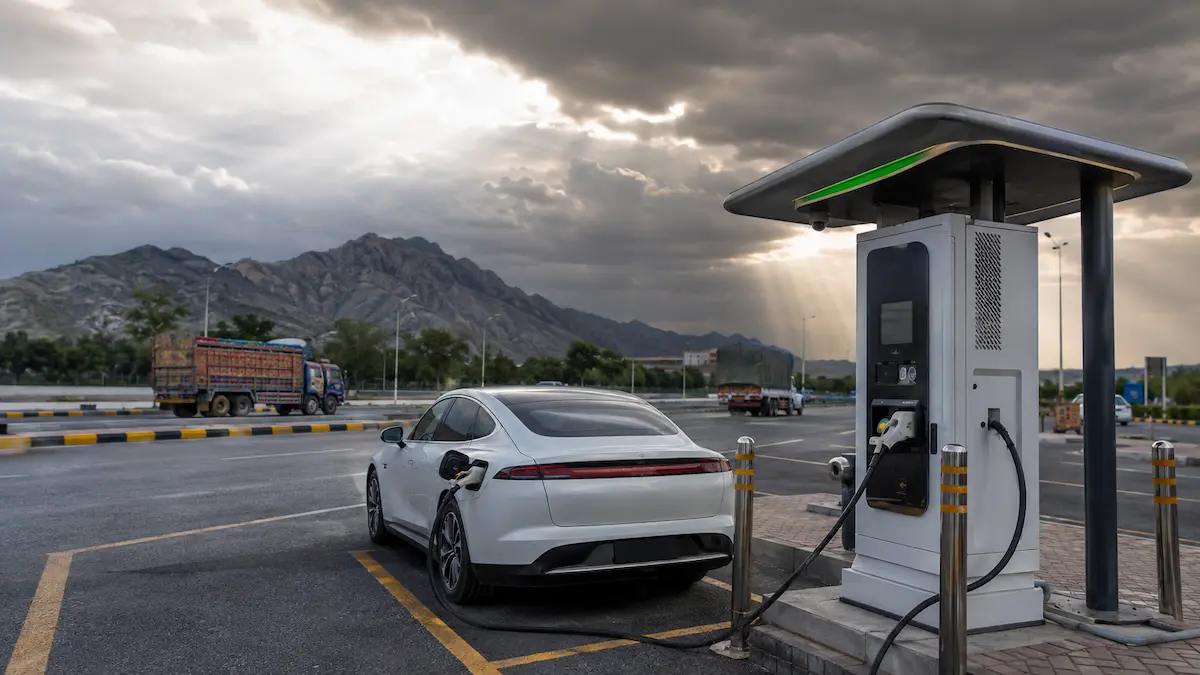
That has changed along the M-2 Motorway. Six operational charging points now connect Islamabad and Lahore, making it Pakistan’s first functioning EV travel corridor. It isn’t perfect, but it works.
M-2 Motorway: Pakistan’s First Functional EV Corridor
The Bhera Service Area is the standout location on this corridor. It houses both 120kW and 90kW DC fast chargers, which is a meaningful specification. At those speeds, most modern EVs can add 100 to 150 kilometres of range in under 30 minutes. That changes the maths on intercity travel significantly.
The other charging points fill in the gaps between Islamabad and Lahore. Kallar Kahar and Pindi Bhattian handle the middle stretch. The PSO station near Ravi River Bridge provides a reliable option close to Lahore. The Dharrabi AC charger is slower but adds a fallback option for drivers who need a top-up rather than a full charge.
| Location | Charger Type | Status |
|---|---|---|
| Bhera Service Area | 120kW & 90kW DC Fast Chargers | Operational |
| Bhera PSO Station | DC Fast Charger | Operational |
| Kallar Kahar | Public Charging Facility | Operational |
| Dharrabi | 7kW AC Charger | Operational |
| Ravi River Bridge | PSO Charging Station | Operational |
| Pindi Bhattian | EV Charging Point | Operational |
What makes this corridor significant is not just the number of chargers. It is the strategic spacing. Drivers with a modern EV carrying 250 to 400km of range do not need to stop more than once or twice. The network is sparse by European standards, but it is functional by Pakistani standards, which is a different benchmark entirely.
Lahore Is Pakistan’s Most EV-Ready City
Among major cities, Lahore has moved furthest in practical charging availability. PSO’s Electro Sunshine Filling Station provides an accessible public charging option given its petrol station format and extended hours. Packages Mall offers fast and ultra-fast charging for drivers already spending time at the mall. The Lahore Civil Secretariat installation signals government-level adoption, which matters for long-term policy momentum.
This concentration of charging options in one city reflects a broader pattern. Pakistan’s EV rollout is happening in layers. Lahore builds density first. Other cities follow. This is not a weakness in planning. It is a realistic sequencing of limited investment into high-impact locations. The grassroots ambition visible in stories of Pakistani athletes mirrors this same pattern of building from the bottom up, city by city, station by station.
Islamabad and Rawalpindi Complete the Northern EV Market
Islamabad contributes to the northern Pakistan EV ecosystem through stations in F-7, I-8, and E-11. The capital’s relatively compact geography, higher household incomes, and early-adopter culture make it a natural fit for EV ownership.
Together, Lahore and Islamabad form a connected EV market. A driver who works in one city and has family in the other can now make that trip electrically. That is a concrete change in lived experience, not a policy projection.
What Changed in 2026: Lower Costs, More Confidence
Two things shifted meaningfully in 2026. First, NEPRA reduced EV charging tariffs, improving the running cost advantage of EVs over petrol vehicles. The reduction matters because public charging economics were previously uncertain for many potential buyers. Lower tariffs encourage private operators to invest in more stations, which builds the network further.
Second, confidence increased. Buyers now see operational infrastructure rather than announcements. This psychological shift is underrated. Pakistan’s National Electric Vehicle Policy has been in place for several years, but policy frameworks alone do not move consumers. Working chargers do.
Where the Network Still Falls Short
The M-2 success has not yet spread across the country. The M-1 toward Peshawar remains poorly served. The M-4 and M-5 corridors connecting central and southern Punjab have minimal coverage. Sindh and Balochistan, which together cover a vast part of Pakistan’s land area, lack meaningful public charging infrastructure entirely.
The N-5 Highway, which connects Pakistan’s major cities from Peshawar to Karachi, should logically be a priority for expansion. It is not adequately served today. This limits EV utility for the millions of Pakistanis who live along this corridor.
This uneven picture matters for buyers. An EV works well as a daily commuter car in Lahore or Islamabad. It requires genuine pre-trip planning for travel beyond these cities. That is a real constraint, not a minor footnote. Knowing about how Pakistan builds competitive strength in stages provides useful framing here. The EV network is following the same gradual build from strength.
What Matters More Than Public Chargers: Home Charging
Public charging gets most of the media attention. Home charging is where most EV owners actually refuel. A buyer who can plug in overnight at home transforms the EV experience entirely. Public fast chargers become occasional top-ups rather than routine necessities.
Before purchasing any EV, Pakistani buyers should check five things: whether overnight home charging is possible, whether daily commute distance fits the vehicle’s range, which public chargers exist along regular routes, whether long-distance travel needs are covered, and whether service centers and parts are locally available.
For urban commuters in Lahore, Islamabad, or Rawalpindi, these boxes are increasingly easy to tick. For buyers outside these markets, the checklist requires more careful evaluation.
The Strategic Insight: Location Matters More Than Numbers
Pakistan does not need thousands of chargers before EV adoption can grow. The M-2 corridor proves this. Six well-placed chargers unlocked practical intercity travel between two of Pakistan’s most important cities. The lesson for policymakers and private investors is that strategic placement of fast chargers along high-traffic routes creates disproportionate value.
This is the most underappreciated insight in Pakistan’s EV story. Network density matters eventually. But in the early phase, network intelligence matters more. Where you put the first 50 fast chargers shapes the entire trajectory of adoption.
Why This Matters Beyond Transportation
Pakistan spends heavily on petroleum imports every year. Even modest EV adoption among urban commuters reduces this burden. The effect compounds over time as more vehicles enter the fleet.
Lahore’s persistent air quality crisis has a significant transport emissions component. A gradual shift toward electric mobility in a city of this size would have measurable public health effects. These benefits do not appear in the monthly fuel bill of individual owners, but they represent genuine national value.
Local EV manufacturing is also being explored, which could reduce import costs and create industrial employment. Pakistan already has a manufacturing base in automotive assembly. The transition to EVs, if managed well, represents an opportunity rather than purely a disruption.
What Happens Next
The near-term priorities are clear: more fast chargers on the M-1, expansion along M-4 and M-5, the first serious charging infrastructure in Karachi, and private sector investment encouraged by the improved tariff environment. Locally manufactured EVs at accessible price points could accelerate adoption across income brackets.
The decisions made in the next two to three years will determine whether Pakistan’s EV transition stays concentrated in two cities or becomes a genuinely national shift. The M-2 corridor has shown what works. The question now is replication.
Frequently Asked Questions
Can an EV travel between Islamabad and Lahore?
Yes. Multiple operational charging stations now make the M-2 Motorway one of Pakistan’s most practical EV routes. Stops at Bhera, Kallar Kahar, and Pindi Bhattian provide sufficient coverage for most modern EVs when planned correctly.
Which city currently has the best EV charging infrastructure?
Lahore offers the widest mix of public charging facilities and fast-charging locations, including PSO Electro Sunshine Filling Station, Packages Mall Charging Hub, and Lahore Civil Secretariat.
Is charging cheaper than petrol?
Recent NEPRA tariff reductions have improved charging affordability. Actual savings depend on electricity rates at the charging location and individual driving patterns.
What are the biggest coverage gaps in the network?
Major gaps remain on the M-1 toward Peshawar, the M-4 and M-5 corridors, large parts of Sindh and Balochistan, and several major cities along the N-5 Highway.
Is Pakistan ready for mass EV adoption?
Major cities are increasingly prepared. However, nationwide charging coverage still needs significant expansion before EVs become a practical choice for drivers outside Lahore and Islamabad.
What is the biggest challenge facing EV adoption?
Reliable charging infrastructure outside major urban centers remains the primary obstacle. Until the network extends to the M-1, N-5, and southern Pakistan, EV ownership requires careful route planning for anyone who travels beyond the two main cities.